ChatGPT Shopping Ads: How E-commerce Brands Use Product Feeds and Shopify
Connect your product feed, group products into sets by margin and price, track orders with their value, and only scale the products where the click price fits your order value.

- Key Takeaways
- Lorem ipsum dolor sit amet
- Lorem ipsum dolor sit amet
- Lorem ipsum dolor sit amet
- Lorem ipsum dolor sit amet
Let’s find the perfect ad strategy for you.
We’ll explore your current setup and see how to scale your business.
Schedule CallKey takeaways
- ChatGPT shopping ads are built from your product feed and show product images, names and prices below the answer, as a single card or a carousel.
- You connect the feed in Ads Manager or through the ChatGPT Ads app for Shopify, which works in every market where ChatGPT Ads run.
- Check the math first: at $3-5 a click, low-priced products rarely pay back on the first order. Higher order values and repeat buyers make the numbers work.
- Creative enhancements are on by default and can change titles, images and even landing page URLs. Review them before you launch a store campaign.
- Your feed also shapes how products appear in ChatGPT's free shopping results, so a clean feed pays off twice.
What are ChatGPT shopping ads?
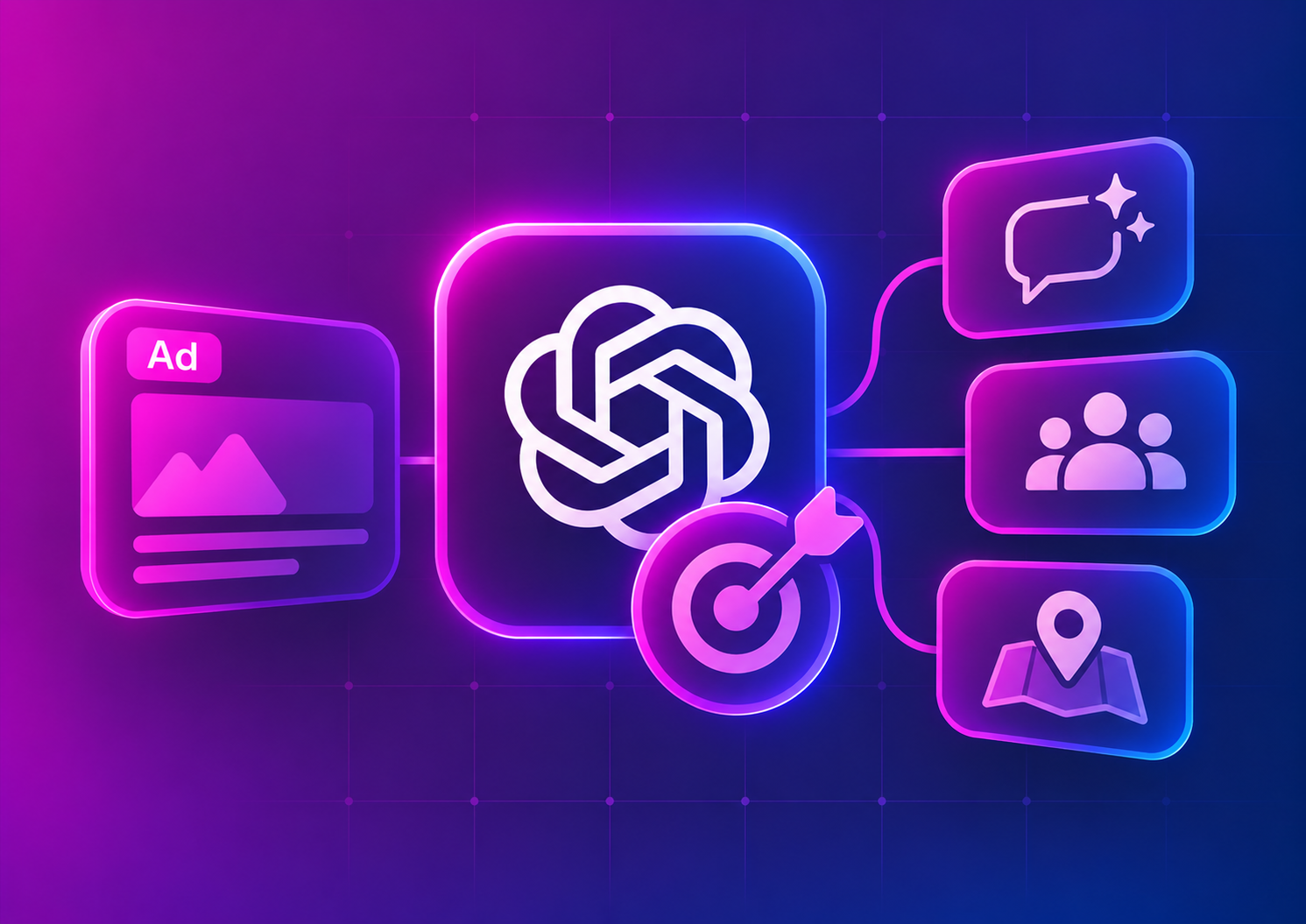
They are ads built from your product feed instead of written by hand. When someone asks ChatGPT for product advice, a shopping ad can show your product image, name and price below the answer, either as one card or as a carousel of several products. Like every ChatGPT ad, they are labeled as sponsored and never change the answer itself.
For e-commerce, this is the format that matters. A standard ad card can promote your store, but a shopping ad shows the exact product someone is asking about, with a price, which is what a buyer comparing options wants to see. We cover the other formats in what ChatGPT ads look like.
How do you connect a product feed?
Two ways:
- In Ads Manager. Upload or connect your feed in the product catalog section.
- Through the ChatGPT Ads app for Shopify. It lets you open or connect an ad account, sync your catalog, create campaigns and track conversions without leaving Shopify. It launched in the US and now works in every market where ChatGPT ads run (Shopify App Store).
Before you sync, clean the feed the way you would for Google Shopping: clear product titles with brand, type and the attribute people compare (size, material, model), good square images, correct prices and stock. ChatGPT reads the feed to decide which products fit a conversation, so vague titles cost you matches.
Business Unicorn tip: I start from the Google Merchant Center feed if the store already has one. It is usually the cleanest product data a brand owns, because Google has been rejecting bad titles and prices for years. Fix the feed once and both channels benefit.
How should you organize products into campaigns?
By money, not by category. Use product sets to choose which products an ad group promotes. Since November 2026, you can combine several conditions on the same product field, which makes it easier to build precise sets (Search Engine Roundtable).
We split stores into three sets:
- Best sellers with healthy margins. The products most likely to pay back. They get the first budget.
- High-price products people research. Furniture, electronics, premium beauty. ChatGPT is where buyers compare these, and order values carry higher click costs.
- Everything else. Leave it out at the start. Add it later if the first two sets work.
If you only deliver to part of a country, product feed campaigns can now target regions or markets inside it, so you stop paying for clicks from places you can't ship to.
Do ChatGPT shopping ads pay off for e-commerce?
It depends on your order value more than anything else. Clicks in e-commerce usually cost $3-5 in the accounts we manage. Your break-even cost per click is average order value × conversion rate ÷ target ROAS, so here is what a store can afford at a 3% conversion rate and a 3x ROAS target:
That does not rule out cheaper products. If customers reorder, judge the click against what a customer brings over 6-12 months, not only the first order. A $50 supplement bought every month is a different business from a $50 one-off gift.
From our work: For stores, we plan a ChatGPT test at $25-70 a day for 90 days, with the products that already have the best margins and reviews. That budget is small enough to stop without regret and large enough to show whether ChatGPT brings orders at a cost the store can live with.
How do you measure ROI on ChatGPT shopping ads?
Track orders with their value, not just the number of purchases. Send an order_created event through the OpenAI Pixel and Conversions API with the order amount, so Ads Manager can report revenue and ROAS. Amounts go in as whole numbers in the smallest currency unit: a $49.90 order is sent as 4990.
Then compare ChatGPT against your other channels on the same terms: cost per order, ROAS and the share of new customers. If you use Triple Whale or Northbeam, both are OpenAI measurement partners, so ChatGPT can sit in the same report as Google and Meta (PPC Land). The setup is in our guide to ChatGPT Ads conversion tracking.
Which settings should a store check before launch?
- Creative enhancements. Since October 29, 2026, they are on by default. The system can rewrite titles and descriptions, resize images, translate text and change destination URLs without asking. For a store with prices, offers and stock, check what it changes or switch it off in Ads Manager.
- Landing pages. Send product ads to the product page, not the homepage, and make sure the price on the page matches the feed.
- Crawler access. OpenAI checks landing pages with OAI-AdsBot. If your firewall or CDN blocks it, ads can be rejected.
- Bidding. Start on Target CPC, then move to Target CPA once orders are steady. Our ChatGPT Ads bidding guide explains how to set both.
Do product feeds affect ChatGPT's free shopping results too?
Yes, and this is the part most stores miss. ChatGPT's organic product recommendations are not ads, but they increasingly come from merchant feeds. Profound's tracking showed the share of feed-based recommendations jump from about 8% to over 61% in July 2026 (Search Engine Journal). Shopify stores already have their catalogs connected to ChatGPT.
So the work you put into the feed for ads also helps how your products appear in free results. That makes the feed the first project for any store that wants to sell through ChatGPT, paid or not. If you want a team to clean the feed, set up tracking and run the test, check out our ChatGPT Ads management.
Frequently asked questions
Yes. The ChatGPT Ads app for Shopify lets merchants open or connect an ad account, sync products, create campaigns and track conversions from inside Shopify, in every market where ChatGPT ads are available.
Not for standard ad cards, which you write by hand. You need a feed for shopping ads that show product images, names and prices.
Most e-commerce clicks cost $3-5, and every campaign needs at least $25 a day in the US. For a first test, we usually plan $25-70 a day. Our guide on what ChatGPT Ads cost covers the details.
By sending purchases with their order value through the OpenAI Pixel and Conversions API, then comparing cost per order and ROAS with Google and Meta. Attribution partners such as Triple Whale and Northbeam can put all channels in one report.
No. ChatGPT's product recommendations in answers are organic. Shopping ads appear separately, below the answer, and are labeled as sponsored.